
I.C.STARS
KANSAS CITY, MO
Years ago, Will Shields, Kansas City Chiefs superstar and Hall of Famer saw a video of Sandee Kastrul sharing her vision and ideas for her organization, i.c.stars, a Chicago-based workforce development program training underserved young adults for jobs in the tech industry. Shields felt strongly that Kansas City needed something like i.c.stars to energize the members of his community who he could see were disconnected and often disenfranchised.
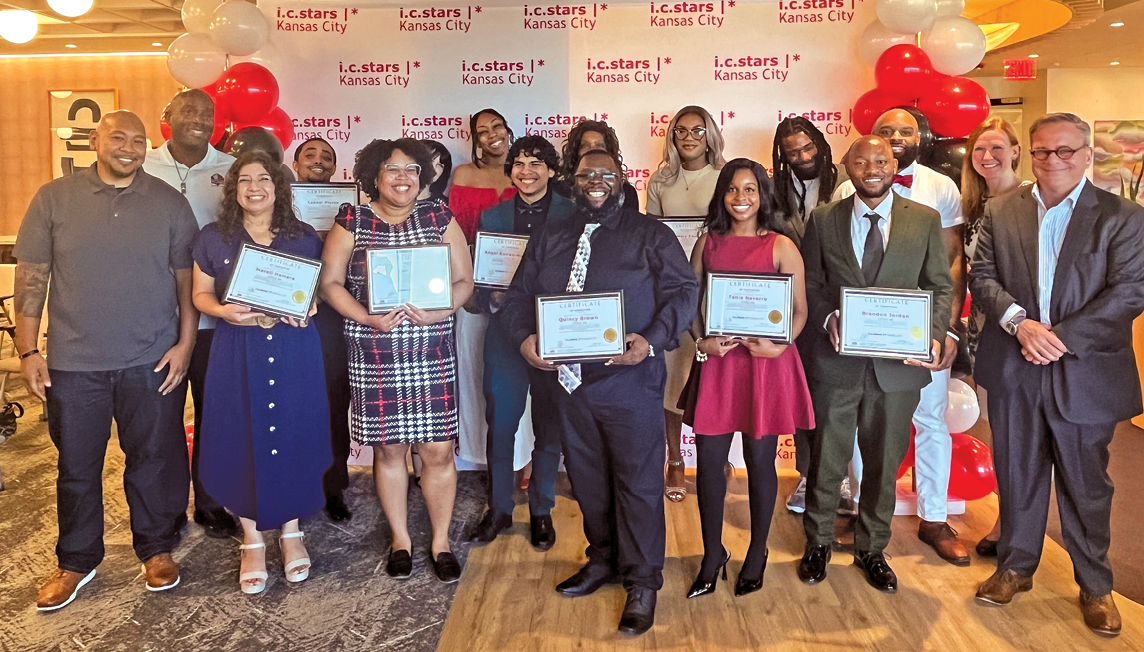
When he contacted the organization, they were already in the process of expanding to Milwaukee, so the i.c.stars team began to work through the same action steps, applying them into Kansas City. They made a fiscal plan and feasibility study, tried to understand who might fund a third operation, who would be the community partners, and who could help recruit and identify participants. But then COVID happed. “We had to pause right as we were getting started,” shares Brian Anderson, director of foundation relations at i.c.stars. “But once we got past the hardest days of the pandemic, we were able to get our seed funding to get us off the ground pretty quickly. We hired our executive director and in September of 2023, we launched our first cohort. Like anything, we’ve had some growing pains as we built brand trust, but now we’re six cycles in and we’re hearing a lot of powerful stories come from those early participants.”
i.c.stars stats are powerful too. They hire 75% of their interns for full-time positions, and most alumni show at least a 220% increase in salary upon completion of the program. The organization also has a 99% alumni volunteer rate, which presents a clear picture of how strongly graduates feel about giving back to the program that changed their lives. The program itself has three cohorts of up to 20 participants each year, with a goal of at least 80% completing the 14-week program and 80% of those graduating finding work within 90 days.
Each 14-week program provides the cohort an opportunity to create a web-based solution to a real challenge that a corporate partner or a sponsored nonprofit in the community is facing. The 20-member cohort provides technical support, receives training to be project and process managers, all while getting a better understanding of the types of tech trials and difficulties experienced by a community partner or corporate entity. The hope is that each cohort will then be hired to fulfill that solution or find other means to continue their growth in a career.
There are many who enter i.c.stars with little to no prior knowledge of the types of advanced technological work they’ll soon become experts in. “Even though every city has its unique cultures and challenges, every city also has a neighborhood or space that is underfunded or disconnected,” Anderson explains. “And those neighborhoods’ challenges are unique. Often, the individuals in those communities don’t have the technical know-how or even the technical equipment to just hop on the internet and do a search.”
Because of this, most participants also find the program through word of mouth. “We have a lot of alumni, or recent graduates, who tell their friends or neighbors, ‘Hey, I just did this program. You need to do it too,’” Anderson says. And their friends listen because they too want the stability and passion, they want the job, that their friend now has.
“I always say that the thing that sets i.c.stars apart from other workforce programs is the cohort model,” Anderson continues. “I come from a social work background, and for a while I was working with long-term individuals in homeless situations where they might finally get a housing voucher and get off the streets, but all of their friends, their social network, was still back at the shelter. And often, they’d have this voucher, but they wouldn’t have a job yet. They didn’t know what to do with their free time during the day. So, they would inevitably come back to the shelter and hang out with their friends, invite some of those friends over to their new space, something would happen, and then they’d lose their housing. It was a terrible cycle.”
“At i.c.stars you’re not just getting exposure to direct potential supervisors and employers through the mentorships and events,” he continues, “but you’re building a group of peers that could start a business with you. And we have many alumni who have built businesses with folks from other cohorts too. For some, they see a need when they’re training together and now they’re working on it, creating a new nonprofit. This is real growth. And it started because both participants said yes to this program.”
i.c.stars takes connection seriously, whether connecting interns and corporate leaders or the individuals in the cohorts, and they’re demonstrating the necessity of connection on as many levels as possible. “We’re practicing what we’re preaching,” says Anderson. “We’re an organization that is innovative with how we’re training and responding to the needs of our community and we’re instilling that in our graduates. And right from the start, we’re showing them the value of connection.”
5 Years Later
“Pre-COVID, we had five days a week in-person training, 12 hours a day; it was a very intensive experience. During COVID, we went completely remote. But we’re back in office now, three days a week, and remote twice a week. The truth is that people were struggling to live their lives when we were in-person 12-hour days, doing 60 hours a week. We had people dropping out because they were a single parent and rent was due, or maybe they’d have to move or maybe their childcare system was no longer working. They’d had to drop out; these were bright minds we were losing. We are being our own barrier to the success of our interns. And so now Monday, Wednesday, Friday is in-person, but Wednesday’s training stops at one o’clock, and that afternoon is spent on health and wellness.”
—Brian Anderson